Humanists in the Hood (Humanism in Practice) by Sikivu Hutchinson
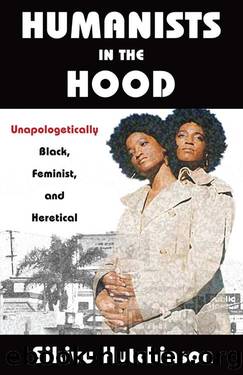
Author:Sikivu Hutchinson [Hutchinson, Sikivu]
Language: eng
Format: epub
Publisher: Pitchstone Publishing
Published: 2020-04-07T04:00:00+00:00
On Gender Politics, Race, and Science
Rigid insistence on the certitude of science is also problematic when it comes to considerations of how gender is constructed. Early-twentieth-century American notions of what gender and gender identity encompassed are markedly different from contemporary ones. There is perhaps no more compelling illustration of the malleability of gender than the movement toward embracing gender nonbinary, genderqueer, and gender nonconforming identities. As a young person growing up in the eighties and nineties, I recall gender-fluid identities being narrowly associated with sexuality, dress, and affect. In the straight, heteronormative America of the Reagan-Bush administration, it was nearly impossible to openly self-determine or self-identify as gender nonbinary in mainstream culture. Those who did so were all but invisible, ridiculed, and disdained as drag queens or âtransvestites,â fodder for pop culture parodies and straight voyeurism in Hollywood La Cage aux Folles retreads or bad Martin Lawrence skits. In this universe, gender expressivity was regarded as a male thing. It was high camp, high performance art, tailored for the straight white male gaze and the cis queer white male gaze. Women of color who âcrossedâ or defied gender boundaries did not have access to the same platforms for public validation in TV and film as white men. This is not to suggest that queer and gender nonconforming white men were accepted in the American mainstream either. Rather, white male privilege has always provided greater visibility for validations of white humanity across gender and sexual orientation. Itâs no mystery that greater openness to LGBTQI communities and same-sex marriage in the white mainstream (versus greater openness to eradicating racial injustice) is closely tied to the growing number of white folks who have white family members and friends who identify as queer, trans, and nonbinary. Again, these trends are amplified by over a decade of pop culture portrayals that center white LGBTQI communities (films and TV shows such as Milk, Transparent, Will and Grace, Queer as Folk, Queer Eye for the Straight Guy and The âLâ Word come to mind). Here, the everyday realities of being a queer Black youth with no health care, job, or home are othered in a media regime that privileges and centers white homosexuality as the norm.
Western humanism is based on the implicit belief that whiteness, maleness, and straightness are the invisible templates for intellectual and moral values. Again, the Enlightenment values that many humanists extol emerged in an era in which slavery, genocide, and colonialism were justified by science and scientific inquiry. Even though the majority of scientists hold that biological race does not exist, Black bodies were and still are used to empirically determine and define racial difference. During the slave trade, the supposedly immutable and observable difference of blackness validated the superiority of whiteness. Blackness and whiteness were forever yoked together as dialectical opposites, completing, validating, and positioning each other in time and space. Despite seeming consensus among the scientific and anthropological communities about race as a âsocial construction,â dissent remains. There is still controversy in modern science about the validity of racial categories vis-Ã -vis genetic diversity.
Download
This site does not store any files on its server. We only index and link to content provided by other sites. Please contact the content providers to delete copyright contents if any and email us, we'll remove relevant links or contents immediately.
| Anthropology | Archaeology |
| Philosophy | Politics & Government |
| Social Sciences | Sociology |
| Women's Studies |
Born to Run: by Christopher McDougall(7132)
The Leavers by Lisa Ko(6950)
iGen by Jean M. Twenge(5419)
Sapiens by Yuval Noah Harari(5375)
Spare by Prince Harry The Duke of Sussex(5202)
The Kite Runner by Khaled Hosseini(5188)
Machine Learning at Scale with H2O by Gregory Keys | David Whiting(4317)
Bullshit Jobs by David Graeber(4197)
Never by Ken Follett(3963)
Goodbye Paradise(3813)
Livewired by David Eagleman(3778)
Fairy Tale by Stephen King(3403)
A Dictionary of Sociology by Unknown(3088)
Harry Potter 4 - Harry Potter and The Goblet of Fire by J.K.Rowling(3077)
The Social Psychology of Inequality by Unknown(3039)
Will by Will Smith(2930)
The Club by A.L. Brooks(2928)
0041152001443424520 .pdf by Unknown(2850)
People of the Earth: An Introduction to World Prehistory by Dr. Brian Fagan & Nadia Durrani(2740)
